Squealing that is not brakes: belts, bearings, pulleys
An engine squeal can come from a belt, pulley, bearing, or accessory. Learn what the timing and sound can reveal before scheduling diagnosis.
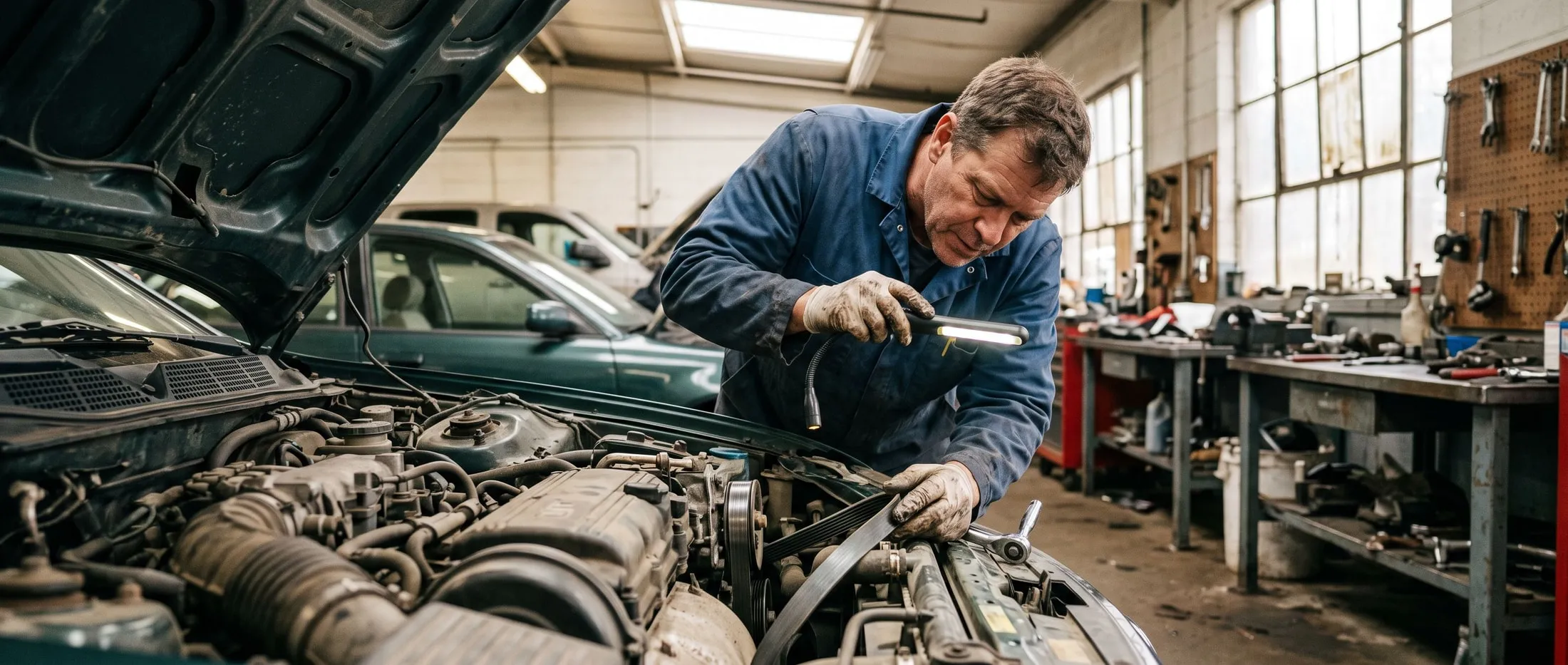
An engine squeal often gets called a “belt noise,” but the belt is only the messenger. On most vehicles, the serpentine belt turns several accessories. A worn tensioner, rough idler pulley, failing alternator bearing, compressor clutch, or fluid contamination can all make a sound that seems to come from the same area. The useful question is not simply whether it squeals; it is when it starts and what changes it.
Listen for the moment it begins
A brief chirp immediately after a cold start can be different from a high-pitched noise that continues after the engine warms. Notice whether the sound follows engine speed, appears after rain, begins as the air conditioner is switched on, or arrives while the steering wheel is being turned at low speed. A squeal during a humid morning may suggest belt slip, while a growl that changes with accessory load can suggest a bearing. A phone recording made from outside the parked vehicle is useful if it can be made safely. Do not lean into the engine bay or ask someone else to rev the engine while you are near moving parts.
Check only with the engine off
After the engine is cool and switched off, a visual check can reveal obvious clues. Look for belt ribs that are cracked, missing, shiny, glazed, or frayed at one edge. A belt that walks toward one side of a pulley may be tracking incorrectly. Also look for oil, power-steering fluid, or coolant around the belt path; a small leak can make a good belt slip. These observations do not prove the failed part, but they help a technician start with the correct system. Do not apply belt dressing, aerosol lubricant, soap, water, or any household product. Those shortcuts can quiet a noise temporarily while making the original cause harder to identify.
Know when the accessory drive is urgent
Stop driving rather than testing the sound if a battery or charging warning appears, the temperature gauge rises, steam is visible, steering suddenly becomes heavy, or there is a burning-rubber smell. A loose or damaged belt can stop turning the alternator, water pump, or other essential component depending on the vehicle. Smoke, a visibly shredded belt, or a loud new metal-on-metal sound also calls for a tow. Even if the vehicle still moves, continuing can turn one failed pulley or belt into overheating, a dead battery, or collateral damage around the belt path.
Diagnosis should isolate the source
An accessory-drive inspection is more than looking at the belt. The technician can check belt routing and tensioner position, spin pulleys with the belt removed when appropriate, inspect for wobble and bearing roughness, listen with diagnostic tools, and measure charging behavior under load. The air-conditioning clutch and compressor may be evaluated separately, because their sound can change only when the A/C is requested. If a new belt is installed without finding a tilted pulley, seized idler, or fluid leak, the new belt may soon begin making the same noise.
Bring a clear symptom timeline
Write down the weather, engine temperature, accessories in use, and whether the vehicle had recent battery, cooling-system, or belt work. State whether the noise is a chirp, squeal, squeak, or grinding sound and whether it fades after a few seconds. That detail is more valuable than guessing which part is responsible. Lloyd’s can inspect engine accessory-drive and charging concerns for drivers in Sandston, Highland Springs, Varina, Henrico, and Richmond. A diagnosis based on the noise pattern and component condition is safer than replacing parts by sound alone.
Avoid confusing a squeal with brake noise
The location can be deceptive. Brake squeal usually changes with vehicle speed and often appears when the pedal is applied, while an accessory-drive sound tracks engine RPM even when the vehicle is stationary. A wheel bearing sound normally rises with road speed rather than a blip of the throttle. Tell the shop if the sound can be reproduced only in gear, only while moving, or only with the A/C on. This distinction can save diagnostic time and prevents an engine-bay concern from being confused with a brake or tire issue.
Do not mistake a recent repair for proof
If the noise began soon after a battery, alternator, cooling-system, or belt repair, mention that timing. A belt may have been removed during unrelated work, but that does not automatically mean the installed belt is defective. Routing, tensioner travel, pulley alignment, and a pre-existing leaking component still need to be checked. The repair record gives the technician a useful timeline without assigning blame before the source has been tested.